November 28, 2025
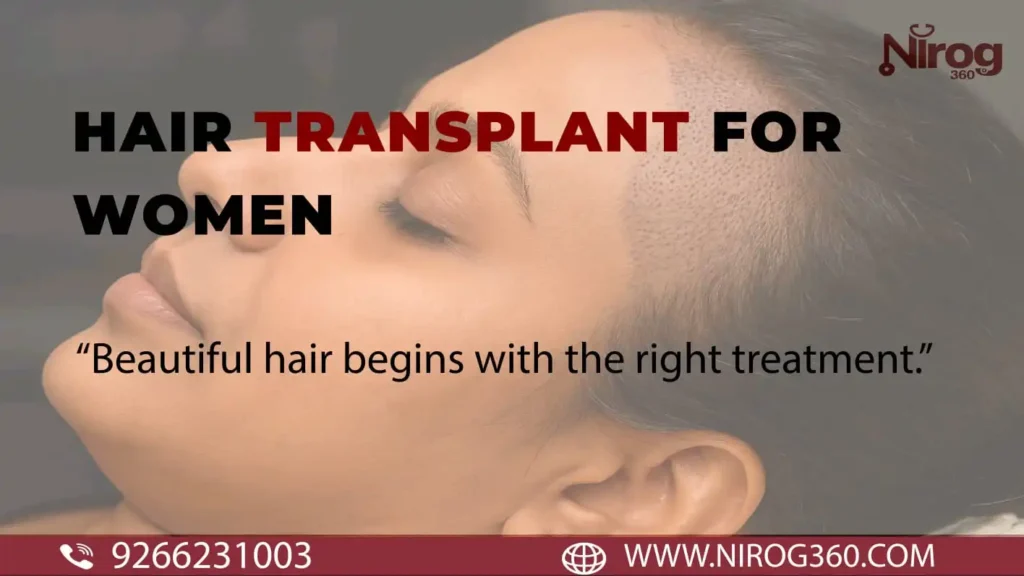
overview
Understanding Female Pattern Hair Loss (FPHL)
The first step before considering hair transplant treatment for women would be to understand the process of hair loss. The common kind of hair thinning in ladies is known as womanish Pattern Hair Loss, which affects millions each over the world.
Common causes of hair loss in women include:
Hormonal imbalance PCOS, gestation, menopause
Genetics
Stress or trauma
Thyroid diseases
Salutary scarcities
Tight hairstyles( traction alopecia)
Autoimmune conditions( alopecia areata)
Unlike men, who are likely to develop one bald spot, women generally have diffused thinning. It’s for this reason that a womanish hair transplant procedure needs a technical approach.
What Is a Hair Transplant for Women?
Why Do Women Need a Different Approach?
Who Is the Right Candidate for a Female Hair Transplant?
Not every woman experiencing hair loss is an ideal candidate. You may be suitable if:
✔ You have permanent hair thinning or bald patches
Localized thinning due to genetics, trauma, or surgery responds very well to hair transplant for women.
✔ You have a stable donor area
A strong donor area is crucial for a successful female hair transplant.
✔ You suffer from traction alopecia
Women who wear tight ponytails, braids, or extensions often lose hair around the front and sides. These areas can be restored.
✔ You have hairline lowering needs
Some women have naturally high hairlines, and a hair transplant can help create a balanced, feminine forehead shape.
Not suitable for
- Temporary hair loss (stress, childbirth, crash dieting)
- Severe diffuse thinning without a stable donor area
Uncontrolled medical conditions
ing elit. Ut elit tellus, luctus nec ullamcorper mattis, pulvinar dapibus leo.
Different Techniques Used in Hair Transplant for Women
1. FUE (Follicular Unit Extraction)
This is the most preferred technique for hair transplant for women today.
Benefits:
- No linear scar
- Faster recovery
- Very natural results
- Ideal for women with localized thinning
2. FUT (Follicular Unit Transplantation)
A strip of scalp is removed from the back and dissected into grafts.
Benefits:
- High number of grafts
Suitable for severe baldness
- However, FUT may leave a linear scar, so it’s less common in a female hair transplant.
3. DHI (Direct Hair Implantation)
A more advanced version of FUE where grafts are implanted directly using an implanter pen.
Benefits:
- Minimal handling of follicles
- Higher survival rate
- Dense packing possible
- Great for restoring hairlines in women
Hairline Design for Women
This is one of the most important aspects of a hair transplant for women. Women need a natural, softer, rounded hairline—not the straight, masculine line used in male transplants.
Key features of a female hairline:
- Lower and rounded
- Softer edges
- High density in the front
- Strategic placement for natural framing
An expert surgeon experienced in female hair transplant will understand these nuances.
Cost of Hair Transplant for Women
Costs vary based on fashion, clinic position, experience of surgeons, and the number of grafts that are demanded.
Average cost( India)
₹ 40,000 – ₹
Global$ 1500 –$ 8000
DHI and advanced FUE procedures generally are on the advanced side.
The following is an expanded and detailed interpretation of your Benefits of Hair Transplant for Women section
Benefits of Hair Transplant for Women
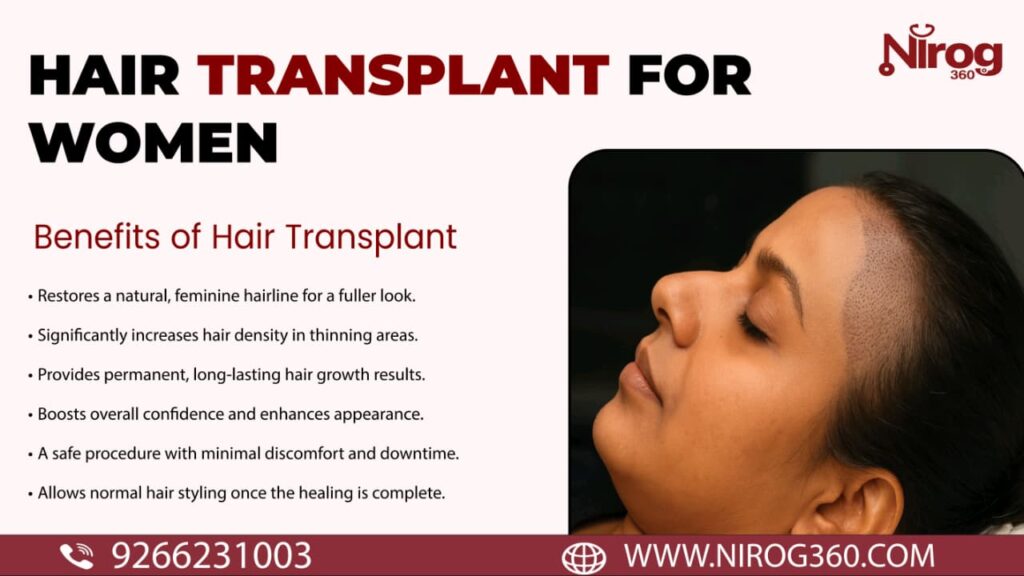
Choosing a womanish hair transplant offers multitudinous advantages that go further simply ornamental enhancement. Then is a detailed look at why this procedure can be life- changing for women passing hair loss
✔ Permanent and Natural Results
Unlike other, frequently temporary druthers
like hairpieces, extensions, or topical treatments, a hair transplant for women provides an endless result. The transplanted hair is taken from the” safe patron area,” and this is genetically resistant to hair loss. Over time, these scattered follicles grow out naturally, blending harmoniously with your current hairs.
Genetics, growing, and traction alopecia are the possible causes of a retreating hairline among women.
✔ Restores viscosity in lacing Areas
verbose thinning is one of the common patterns of hair loss in women.
✔ minimum time-out
ultramodern styles of FUE and DHI are minimally invasive, generally performed under original anesthesia. The recovery is rapid-fire most women can get back to normal conditioning within a many days. There are no extended hospitalizations or long ages of time-out needed, which makes it veritably readily for women with busy schedules.
✔ safe-deposit box and Proven fashio
Hair transplant procedures are extensively regarded as safe when performed by trained and endured surgeons. Complications are rare, and ultramodern technology ensures that follicles